Great American Beer Festival results announced

176x200In Denver this past weekend was the Daytona 500 of beer festivals, the Great American Beer Festival. As much as I wanted to go, I couldn’t fit it into my budget for the year. Brewgrass had to do for me… However, it’s my goal to make it to the GABF next year. Time to start filling that piggy bank.

Started in 1982 by the American Brewers Association, this festival has grown into the premier beer event in the United States. Winning a medal at the GABF is one of the most prestigious awards a brewery can attain. This year, 495 breweries submitted 3,308 beers into the competition.

Breweries from Colorado, California and Oregon dominated the medals. I’m not going to accuse anyone of a west-coast beer bias, but their dominance is a little deceiving given sheer number of breweries from those states. The beer they make out there is great, but I think Colorado alone has more breweries than the entire Southeast.

Some of our Southern Breweries did represent and bring home some hardware. I’ll give a special congratulations to the Upstate South Carolina’s own RJ Rockers for winning a gold medal in the English-Style Summer Ale category with their Light Rock Ale.

Congrats to the other breweries from the Southeast that won medals:

Duck-Rabbit Craft Brewery, Farmville, NC
Gold: Duck-Rabbit Barrel Aged Baltic Porter – Baltic-Style Porter
Bronze: Duck-Rabbit Barrel Aged Baltic Porter – Wood- and Barrel-Aged Strong Ale

Foothills Brewing, Winston-Salem, NC
Bronze: Sexual Chocolate Imperial Stout – Imperial Stout

Red Brick-Atlanta Brewing Co., Atlanta, GA
Bronze: Red Brick Anniversary Ale 15 – Wood- and Barrel Aged Beer
Bronze: Numbers Ale – Ordinary or Special Bitter

Sweetwater Brewing Co., Atlanta, GA
Silver: Motorboat ESB – Extra Special Bitter or Strong Bitter

Blackstone Brewing Co., Nashville, TN
Gold: St. Charles Porter – Brown Porter

Cigar City Brewing, Tampa, FL
Gold: Humidor Series IPA – Wood- and Barrel Aged Beer

Brewzzi, West Palm Beach, FL
Silver: Boca Alt – German Style Altbier

Some other results from the medal awards that I found interesting:

  • Milwaukee’s Best and Keystone Ice won gold medals and Steel Reserve won a bronze. Were the judges already drunk when they sampled these?
  • Best beer name: “TPS Report” from Trinity Brewing in Colorado Springs won a gold in Experimental Beer.
  • Flying Dog took home the award for Mid-Sized Brewery of the Year.
Posted in Beer events, Beer-related news | Leave a comment

homebrew workshop at Coast on October 10

Coast Brewing Co. in Charleston closing their homebrew shop on October 10. As many local homebrew shops have found over the years, it’s tough compete with the prices and selection of large online suppliers.

On one hand, that sucks, but on the other, it has created a good opportunity for some enterprising homebrewers. To celebrate the homebrew store closing, Coast is going to offer a homebrewers workshop on October 10. David is going to teach the participants how to brew all-grain using the homebrew setup they have at the brewery. The style and recipe will be determined by the participants.

They are only opening the workshop up to 10 people. Cost will be $100. You can contact Jaime at 843-343-4727 or jaime@coastbrewing.com to reserve a spot.

I can say from my time interning at the brewery that David really knows his stuff and is a very good teacher. You’ll probably learn more in that afternoon than you would in a year on your own. If you’ve ever wanted to start homebrewing or make the leap to all-grain, I think it would be worth attending.

Posted in Beer events, Homebrew | Leave a comment

Brewgrass 2009

Last Saturday was my first Brewgrass Festival in Asheville, North Carolina. This was the 13th year of this event that combines craft beer and bluegrass. This is one of the hottest tickets in beer festivals. Tickets went on sale back in February and it sold out within about two weeks.

About 3,500 people attended this year’s festival, which was held at Martin Luther King Park, a small baseball field downtown. It ran from noon to 7, so we knew we had to prepare and dig deep for 7 hours of beer sampling. Being a rookie, I admit I was a bit nervous.

The weather ended up being perfect for the day. It had been raining in Asheville all week up to Saturday, and it even rained heavily on Sunday, but for 12 miraculous hours on Saturday, it threatened but held off. The cloud cover kept it cool and pleasant.

We arrived about 30 minutes early to stand in line before the gates opened. While I’m not a proponent of waiting in lines, this was for a good reason. Many of the breweries that attended brought some rare goodies, so this is not a time to be fashionably late. Word spreads fast through the crowd where the good finds are, so those rare gems go quickly.

Accompanying us on our beer odyssey was a strong showing from the Upstate Brewtopians, our local homebrew club. A dozen or so of us set up camp just inside the entrance. Many of the Brewtopians were veterans of Brewgrass, so they had a lot of tips for us rookies.

One of the best strategic calls from one of the club vets was to bring the wrought iron poll and carved wooden Brewtopians sign. It can get pretty hectic with 3,500 people on a baseball field, especially after a few hours of beer sampling. If you ever got lost or disoriented, you knew you simply had to find the flag to make it back to home base. That came in handy.

brewtopians flag
Home base

The Beers

Brewgrass is purely craft beer festival. There was no representation from any of the big breweries. It kept the focus on the beer, rather than the marketing spectacle that the big breweries usually put on. Most of the 40-some-odd tents there were from local and regional breweries. A few national breweries were represented, such as Sierra Nevada, Rogue, Oskar Blues and Kona.

There was a lot of good beer to be had, but the hottest beers, and my favorite selections of the day, were the barrel aged beers. Stored in bourbon barrels, these aged beauties require patience and cunning skill. Drink them too soon, and they won’t have a chance to mellow into the smooth, velvety masterpieces that realize their full potential. We’re talking at least a full year. That’s a long time to wait for a beer.

Three in particular stood out. Coast’s barrel-aged Blackbeerd Imperial Stout, Foothills’ barrel-aged Sexual Chocolate Imperial Stout, and Old Hickory’s three Barleywines aged in different bourbon barrels. One was in a Jack Daniels barrel, another in a Pappy barrel, and the other was in an Irish whiskey barrel that I can’t recall the name of.

withcoast
Me with Jaime and David from Coast

While the Coast and Foothills stouts were so rich and smooth, the Old Hickory barleywines were my favorite of the festival, specifically the Pappy barrel. The three selections were distinguishable from each other, but I felt the Pappy just tasted a little better to me than the others. I don’t believe I’ve had a barrel-aged Barleywine before, so it was a delightfully unique experience.

Aside from those barrel-aged beers, some of my other favorites included Yazoo’s Hop Project, a double IPA made with fresh Amarillo hops, Ham’s Double IPA and Appalachian Craft Brewery’s Witbier. I missed out on the 2006 Rogue Old Crustacean which I heard was excellent. That made me sad for a short time.

gnome taps
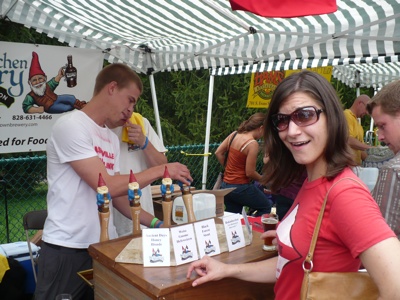
Nicole was enthralled with the gnome taps from Heinzelmannchen Brewery

Tips For Novices

Since this was our first time at Brewgrass, we were not very prepared for a full day of sampling. We picked up a few tips for next year. Here is a bit of what we learned:

  • Bring a CamelBak. There was plenty of water available at each tent for both rinsing your glass and staying hydrated, but it would have been much more effective to have a gallon or so with me all day.
  • Be sure to use sunscreen, even if it’s cloudy. One guy in our party got a burn, despite the cloud cover. Then again, he was as pale as I am, so that might have been a factor.
  • Bring folding chairs. I didn’t think to see if they were allowed. Most of the time you’re up wandering around in search of beer, but it’s good to take a break now and again.
  • Pretzel necklaces are key.
  • Pace yourself. I was experiencing extreme palate fatigue by about 5. You don’t want to run out of steam early.

It was a very fun day and a well-run event. Many of the brewers from the regional breweries were there, so it was cool to be able to meet them and talk to them about their beers. I highly recommend this festival if you have the chance to go. Be on the lookout for tickets next February!

doin the butt
Nicole gets branded by Julie from Bruisin Ales

Posted in Beer events | 4 Comments

don’t fear canned beer

When many of us think of canned beer, flashbacks to college parties or tailgates often come to mind. Coolers full of Natty Light, The Beast, PBR. And is there a better sound than cracking open a cold can of beer? The hiss of carbonation, the crinkling of aluminum. Fond memories, for sure.

It’s precisely because of those memories that most of us associate canned beer with cheap, bad-tasting light beer. And for the most part, it’s a valid association. Most beer that we see in cans is from the larger breweries and it is typically your run-of-the-mill Standard American lager. Over the years, canned beer has developed a very bad perception.

mamas pils
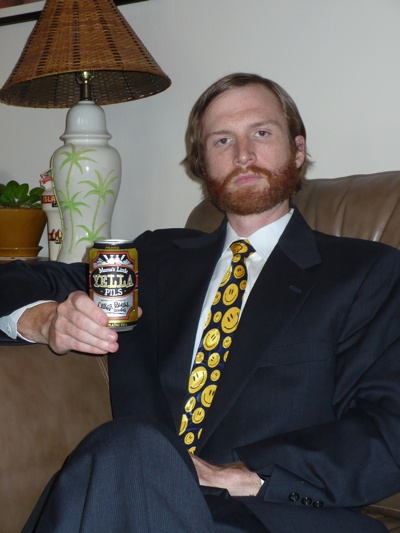
Oskar Blues Mama’s Little Yella Pils, canned beer for the sophisticated palate.

That perception has slowly begun to change over the past few years. A few craft breweries have begun canning their beer. Oskar Blues in Lyons, Colorado, championed the cause back in 2002 when they became the first microbrewery to can their beer. Since then, about 40 other microbreweries have started canning beer, including Surly in Minneapolis, Sly Fox in Pennsylvania and New Belgium in Fort Collins.

Given the perception surrounding canned beer, it is quite a risk for craft breweries to can their beer. After all, if it’s in a can, it can’t be good, can it? Good beer is only in bottles, right? Doesn’t the aluminum impart a metallic taste to beer? Yes it can, no it doesn’t and no.

Perhaps way back in the day, steel cans may have given the beer a metallic taste, but that is no longer a problem. Cans are now lined with a space-age polymer that prevents any such tainting of flavor. (Ok, I made up the space-age polymer part, but the cans are lined with a water-based epoxy to protect the flavor of the beer. The beer and aluminum don’t come into contact.)

Cans Are Better For Beer

As a matter of fact, cans are a much better container for beer for two primary reasons:

  • Cans don’t allow in any light. Beer gets skunked when it is exposed to light. Even brown bottles, which block most of the light that damages beer (clear and green bottles are worthless), allow in some light. With enough exposure, beer in brown bottles can get skunked.
  • Can don’t allow in any air. When beer comes into contact with oxygen, it can get oxidized. Oxidation results in beer tasting papery, cardboardy or stale. Bottles, for the most part, are sealed very well. However, over time, air can slowly seep in through the seal on the cap and result in an oxidized, stale beer.

For the most part, if you are drinking fresh beer that has been handled well, bottles will serve just fine. Cans do provide an extra measure of protection and help preserve the freshness of the beer.

Cans Are Better For the Environment

Not only are cans better for the beer itself, they also provide numerous benefits to the environment:

  • Cans are more compact and weigh less than bottles, so they are more space efficient and cost less to ship.
  • Aluminum is more easily recyclable than glass. Consumers are also more likely to recycle aluminum than glass.
  • Cans don’t break, which make them ideal for outdoor activities such as camping, boating, tailgating and hiking.

Cans Are More Fun

Why don’t more craft breweries can their beers?

The primary reason is the initial cost to switch to cans. A small commercial canning line is much more expensive than a bottling line. Canning systems have become more affordable, thanks to Cask Brewing Canning Systems, which has engineered a relatively low-cost system designed for microbreweries. Still, Oskar Blues spent about $45,000 for their canning set-up, and many small breweries can’t afford that type of up front investment. Larger canning lines can cost over $200,000.

However, if a brewery can swing the initial investment, the savings over time can be significant. Shipping costs will be substantially lower due to lighter-weight aluminum. They can also save on labels and glue. In addition, breweries have seen substantially higher sales growth for their canned selections, as people have become more aware of the benefits of canned beer.

I’ll leave you with one final thought: Draft beer is served in a 1,984 ounce can, also known as a keg.

Posted in Practical Beer Tips | 2 Comments

Jimmy C’s beer bottle cap collection

Jimmy C (aka Jim Ciallella) from OrangeCoat shows us his 400+ beer bottle cap collection. It’s about 20 minutes long, so you may be asking yourself, “How can they talk about bottle caps for 20 minutes?” I don’t know, but we did, and I find it to be a fascinating look at beer history and the evolution of different beer brands, such as Miller and Budweiser.

As a special bonus, Jimmy also shows us his trick for popping bottle caps without bending them. (That’s around the 3:00 mark.)

Posted in Interviews, Practical Beer Tips, Videos | Leave a comment

brew day at Coast

I was able to make it down to Coast again for two more days this week. It actually worked out well for me, as I was in Columbia over the weekend for a fantasy football draft, so I went down to Charleston Sunday night.

In case you’re curious, I got Michael Turner, Brady, Boldin, Thomas Jones, Marshawn Lynch, Eddie Royal and Braylon Edwards with my 1st 7 picks (6th slot out of 10, PPR league). I like my squad, especially after week 3 when Lynch comes back, but I did get Fred Jackson as a handcuff.

Where was I? Oh yes, beer…

I was very excited for this week, since Coast was going to brew up their first ever barleywine on Tuesday. However, that meant that Monday was actually very busy. In a commercial brewery, at least a small one, brew day actually begins the day before.

Monday

The first half of Monday was just like a typical Monday at Coast. Since it’s shipping day, we cleaned and filled kegs to go out to the distributor.

Around 1:00 we finished with that and then began preparations for Tuesday’s brew. The first thing we had to do was move the Double IPA out of fermenter 3 and into one of the empty bright tanks. For you homebrewers out there, a bright tank is essentially used for secondary fermentation. You can make additions and even keg beer straight from one of these tanks.

David wanted to add some whole leaf cascade hops to the bright tank to give it some additional dry hopping. To increase the efficiency of the hop oil, we first hand crushed the hops into a nylon bag. So yes, that means that if you have a Double IPA a few weeks from now, I had my hands on your hops. I hope you enjoy it as much as I did.

After sanitizing the bright tank, we tied the hop bag to a rod inside the tank and began moving the beer. Once that was completed, we cleaned the fermenter to get it ready to hold the beer we were brewing tomorrow.

While the water and PBW was circulating in the fermenter, we started milling the grain to be used the next day. Since we were going to brew a barleywine, which is a high gravity style, we had a LOT of grain to crush. We milled about 15 50-pound bags of grain. That comes out to around 750 pounds.

One other interesting tidbit about Coast’s system. They have 15-barrel fermenters, but the brewing system is only 7.5 barrels. (A barrel is 2 full kegs.) That means that to get a full batch of beer, they actually brew two batches.

While this method is less efficient time-wise, one advantage is that if they don’t hit their gravity or some other desired effect on the first batch, they can compensate on the second batch and get the final product exactly where they want it.

We finished up around 7:00 and I headed out to Moe’s Crosstown Tavern for a burger. I think David stuck around a little while longer to wrap up. It was a long day.

Tuesday, Brew Day

Brew day started at 7 am, although I was a bit late. I underestimated the traffic in North Charleston that early. I didn’t arrive until 7:30. Remind me not to live in North Charleston.

Typically, since Coast brews two batches on brew day, David usually starts around 5 or 6 am. However, we were able to start a bit later because we were only doing one batch today. Due to the amount of grain in one batch, it would make for a very long day to do both in the same day.

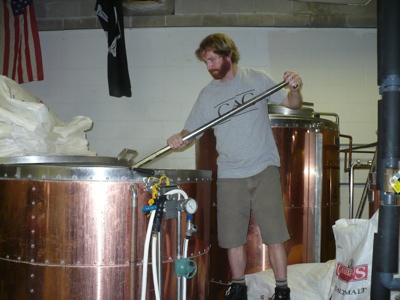
My first task of the day was to give the mash tun a quick rub down and start the sanitization process on the fermenter. After I finished that, we started pumping the strike water into the mash tun and began mashing in.

in the mash tun

Scott and Rich from the Charleston Beer Exchange joined us for the day, so they also got to participate in the festivities. They were especially helpful during the mash-in.

coast brewers
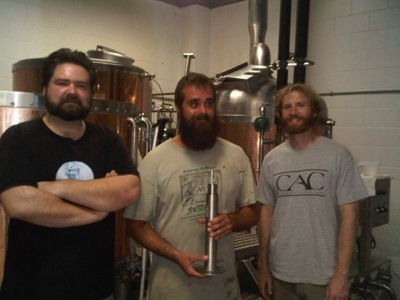
Rich, David and myself. David is not holding a brewing trophy. It’s a hydrometer.

Trying to stir 750 pounds of wet grain is not easy. Between the four of us, we were able to relieve each other as fatigue set in. It was like white water rafting through oatmeal. I think my deltoids are still sore today.

stirring

This barleywine pushed the mash tun to its limits. The beer took more grain than Coast’s Blackbeerd Imperial Stout, which is the highest gravity beer they have made to this point. We filled the mash tun nearly to the top.

750 pounds

Once we were all mashed in, it became a lot like a brew day on my porch. We mashed for about two hours. Then it took about an hour to transfer the wort and sparge the grains. The boil took almost two hours.

Since we were only doing one batch today, there was considerable down time. It was by far the most laid back of my days at the brewery. Brewing is one of those activities where it’s like you hurry up and do something, then you have 30 minutes or more of waiting for something to finish.

You can try to be efficient and clean something or get something else ready while you’re waiting on one thing to finish, but sometimes there is nothing to do but wait. That’s always a good time do a little “quality control” and sample the fruits of your labor!

I had to leave at 5:00 to make it back to Greenville for dinner, so I wasn’t able to see brew day to the end. Since this was such a big beer, it took a lot longer than most brews Coast has done. However, I left the beer in good hands :)

Lessons Learned

After being exposed to most of the different activities that go on at Coast over the four days I’ve worked there, I am in awe that David and Jaime have been able to operate the brewery by themselves. Jaime helps out with the brewing operations, but her primary responsibilities on the business end of things.

With all there is to do and know, it’s amazing that David handles most of the brewing activities himself. I wouldn’t even know where to begin trying to assemble a commercial brewery. While the process of brewing beer is the same no matter what scale you have, there is so much more equipment that you have to know how to operate, and even repair yourself.

For instance, if the pump on the sanitizer jug went out on the keg washer, I’d be sunk. Or if something went wrong with the boiler, or the CO2 compressor, or the brewhouse manifold, and on and on. I guess after 10 years of commercial brewing, you pick up a thing or two, but from my perspective it borders on miraculous.

Final Thoughts After My First Two Weeks

Overall, I have had a great time over the past two weeks, and it’s been an incredible learning experience. I feel very at home in the brewery, and I could see myself brewing commercially some day.

However, I was also very fortunate to be in a brewery that was small enough to where I could help out in all aspects of the process. From week to week, you do a lot of the same things over and over, but at least each day is different from the last. There is a lot of variety in what you do.

If I were starting out in a larger brewery, I would probably be assigned one particular task: cleaning or filling kegs, running the beer filter or bottling line, etc. If I had to do the same thing every day, I’m sure it would get monotonous after a short amount of time. Like anything, I’d have to “put in my time” before being given more responsibility.

So where do I go from here? Well, it’s week-to-week. I can’t go down to Charleston next week, so I’ll have to see if I’ll be able to make it down in the coming weeks. I have some other things going on in life, so there’s no way for me to know. I am very thankful to David and Jaime for allowing into their livelihood, and I hope I can make it down at least a time or two more before the clock strikes midnight.

All I know is, nothing over the last two weeks has discouraged me. If anything, I’m fired up to keep going. As a matter of fact, I’ll be brewing up 10 gallons of Untamed IPA this weekend. It’s a far cry from the 300 gallons I helped brew Tuesday, but with some new found knowledge, this could be my best brew yet.

coast skull

Posted in Breweries | Leave a comment

the prodigal intern returns to The Coast

If you’re a long-time reader of this blog, or if you’ve known me personally for more than 15 minutes, you probably know that I’ve been homebrewing for about two and a half years, and I’ve had thoughts of going pro at some point in my life. I never really pursued it seriously, most likely because I figured that, like many hobbies, if you did it day in and day out, it would lose its luster and become “work” like anything else.

P1020660

I finally decided to do something about it and test this theory. About two months ago, I contacted Jaime at Coast Brewing Company and asked if they could use a hand. I got to know David (the brewmaster) and Jaime (his wife and co-owner) about two years ago when they first opened the brewery in Charleston.

We were at their grand opening celebration in October 2007. (To show you how much of a noob I was at the time, if you read that post, you might notice in my descriptions that I got the Kolsch and Hop Art mixed up. Doh! Humble beginnings…)

How In the World Did You Get This Job?

I approached Coast with my suggestion because I felt we had a good relationship, they know I love beer, I think they are cool people, they are still small enough to where even an inexperienced hand could be very helpful, and most importantly, I really respect and enjoy their beer. David is one of the most talented and imaginative brewers that I’ve come across, and to have the chance to learn under him would be an unbelievable opportunity. Even if it was just for a short time.

So, for a reason which may forever remain a mystery, Jaime and David agreed to let me drive 200 miles to spend a couple days a week with them. Maybe they figured if I was insane enough to commute three hours to come to work, I was serious about what I was doing. Or maybe it was my red beard. (And a special thanks to Phil, Eric and Lindy for letting me crash at their respective houses. I couldn’t do this without your help!)

My First Day

Monday morning I got up, lifted weights at Phil’s house and felt really good about the day. After having my traditional coffee and cereal for breakfast, I began my morning commute. After working at home for over a year now, I often forget about the frustrations of traffic. Dorchester Road in North Charleston was insane. It was a solid 2-lane artery of cars for as far as the eye could see. It took me roughly 30 minutes to travel 6.5 miles. I don’t know how people do that every day.

entry

I got to the brewery around 9, ready to do whatever they had for me. Mondays are shipping days at Coast, so my first task was to help clean kegs and get them ready to be filled. The distributor usually arrives around noon to drop off empty kegs and to pick up their order for the week.

I first learned how to take apart and reassemble the opening of a keg. It’s often a good idea to open up and physically take a look inside a keg to make sure there is no dried or caked on beer stains. Often, these kegs are left outside, and especially in the summer, if there is anything left in the keg it can bake to the inside.

cleaningkegs

If a keg is pretty dirty, you can take a hose and a carboy brush and try to remove as much of the stains as possible before hooking it up to the keg washer. The washer puts the keg through a couple rinse cycles before a caustic acid wash to remove any residue or build up. Once that is complete, it is rinsed with a sanitizing solution, and CO2 is blown in to get everything out and fill the empty keg. At that point, they are ready to be filled with beer.

I also had the chance to fill a few kegs for the day’s shipment. I don’t know where those kegs were headed, but if you are having Coast Kolsch within the next week or two, there’s a chance I had a hand bringing it to you!

The distributor dropped off about twenty or thirty empty kegs, so after lunch I spent a couple hours cleaning those, getting a head start on next Monday’s shipment.

Around 3:00, after the kegs were finished, we set out to clean out a couple empty grundy tanks. These 7 barrel (a keg as we refer to it is a half-barrel) containers hold finished beer to be kegged or bottled at a later time. They are also on wheels, so they can be filled and moved into the large walk-in fridge for storage.
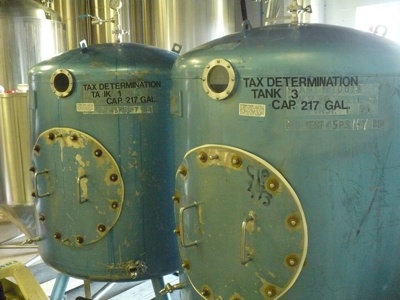
grundytanks

The cleaning process is pretty much the same for homebrewing as it is in a commercial brewery. You first use a base cleaner, such as Five Star PBW, to clean the inside of the tank. This is done by hooking up some large hoses to a couple of the orifices of the tank, pumping water inside and then circulating the water with the cleaning solution.

After cleaning with the base, the same process is used with an acid solution, such as Star San, to sanitize the tank. It’s always clean then sanitize with every piece of equipment that touches finished beer. It’s the same thing I do in my house, just with a lot bigger stuff.

Once we were done cleaning everything, it was time to unwind. The perks of the job are quite nice. Namely, that you’re in a brewery. It was a rigorous day, but not too tiring. I still had enough energy left by the end of the day for a little Rock Band with Red and Lindy. Rock on, Mississippi Swamp Gator!

Tuesday

Tuesday was more of a learning day for me than Monday. Our goal for today was to filter 15 barrels of Kolsch. My first task was to set up the filtration system. It consists of about 20 filter pads sandwiched in between plastic plates. These plates have holes in two corners where the beer enters and exits. The rest of the plates have ridges in which the beer flows.
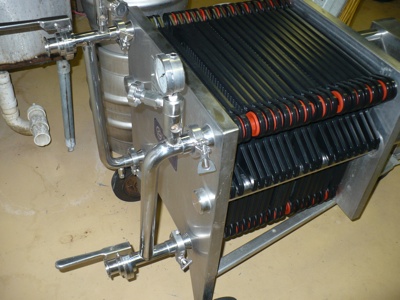
filter

As the beer passes through the ridges, yeast and other particles that are in the beer as it flows in get caught by the filter pads. So as to not filter out any additional flavors and color, Coast uses a fairly open filter pad since they are primarily targeting yeast.

Once the filtration system was cleaned and sanitized, it took about four hours to run all the beer through and into the two grundy tanks that we cleaned out the day before. I was able to sample the beer pre-filter and post-filter, and while the beer coming out was certainly clear as a bell, the beer going in (which was slightly cloudy from the yeast still suspended) was noticeably distinct and in my opinion, a little tastier. It was slightly more fruity and bitter than the filtered beer.

As I learned from David, filtering is one of the riskiest processes in commercial brewing. Any time you move beer or expose it to the elements, you run the risk of contamination. Even though the filtration system is fairly closed and we sanitized everything thoroughly, there is the risk of the filter getting stuck if too much sediment accumulates. Luckily, it went smooth as silk for us, but a stuck filter is a serious pain and is difficult to fix.

Why filter, then? Well, in this case, it’s all about appearances, unfortunately. A kolsch style of beer is expected to be clear and golden, much like the standard lager that dominates the marketplace. In order for the kolsch to sell, it has to be clear. It’s one of the unfortunate consequences of being a commercial brewery. If I were doing this in my house, it wouldn’t matter, but when you have sales to make, sometimes you have to do things that are not ideal.

The filtration process took about four hours, and in the downtime we cleaned out the hot liquor tank. That process involved circulating a hot acid solution in the tank for about 30 minutes to remove any mineral deposits that can accumulate from the water supply.

Once we finished filtration and cleaned all that up, we cleaned out the tank that the unfiltered beer was in. I nearly killed myself sticking my head inside the tank as it was filled with CO2 from the cleaning process. Not a good idea, since we don’t breathe CO2 very well. Kind of like sticking your head under water. Other than that, I’m no worse for wear!

Lessons Learned

Perhaps the most apparent lesson I learned in two days in a small commercial brewery is that brewing commercially is not that much different than homebrewing. Beer is beer. Most of the time in a commercial brewery is spent cleaning and sanitizing, much like it is at home.

At Coast, for instance, they only brew one day a week for the most part. Occasionally they’ll brew twice in a week. The rest of the time is spent cleaning stuff, moving beer around, preparing shipments and doing general maintenance. It’s not glorious work, and that’s why a lot of beginning homebrewers don’t stick with it. Once they learn that brewing is a lot more work than just brewing, it becomes a lot less attractive. You have to love it, or you won’t put in the effort.

The biggest difference is obviously the size and complexity of the equipment. At home, I don’t have to worry about glycol cooling systems, CO2 regulators, industrial water pumps, or steam-heating 400 gallons of water. There are a lot of parts and pieces, and it takes a pretty mechanically inclined person to maintain, let alone understand, all those systems.

That’s when my head would start to spin. From my homebrewing experience, I have a pretty good handle on the beer part of it. However, I have very little mechanical experience, so that’s where I have the most to learn.

Final Thoughts From My First Two Days

I loved it. I had an absolute blast. David was a great teacher and I learned a ton. He always stayed patient when he had to explain things several times, and he kept his sense of humor, like when I was about to disconnect the hose from the hot liquor tank from the wrong side of the valve.

What was also so cool about the experience was how the brewery is truly a “results-oriented work environment.” No one cares what you look like, what you talk like or what you do. It’s all about getting the job done. Does the beer get made and does it leave the brewery on-time and in good condition? It’s very refreshing, especially since we live in a world that judges by appearance and words, not as much by action.

You never know whether a hobby can become a job, or if something you enjoy will become a chore when you do it every day for an extended period of time. That being said, I could see myself in this environment and really enjoying it. Coming from 10 years of work behind a desk, it was exhilarating to be physically involved in my work, to have my hands on something tangible.

I’m not sure what’s going to happen for me from here, but all I know is that I’m looking forward to next week. I’ll be back down there Monday and Tuesday to report for duty. I’m hoping Tuesday will be a brew day. Flippin’ sweet!
sign

Posted in Breweries | 5 Comments

Cleveland beer tour, part 4 – The Brew Kettle

If I had known exactly what The Brew Kettle in Strongsville was, I certainly wouldn’t have made this my last stop on the beer tour. I probably would have gone there when I first got to Ohio and asked them if I could have tossed a sleeping bag in the back and just slept there. It’s pretty much a beer lover’s dream.

brewkettle

The Brew Kettle is a three-in-one establishment. It’s a smokehouse, a brewpub and a brew-your-own for homebrewers. Is there a downside to any of this? As long as the products are tasty, not that I can see. I had heard from my dad about this place, as he went there on a visit to Ohio a couple years ago, and he’s been raving about it ever since.

What I did not realize until going there myself was that they function as a brewpub, sell their own beer on draft in the bar and in bottles for you to take home. I thought it was simply a place that you went to brew your beer and you could have a sandwich while doing so. It’s a far better experience than that.

There are a few pluses and minuses that I see to this type of set up. On the plus side, you basically get to use professional-grade equipment to brew your beer. They have copper brew kettles, a grain mill, a counter-flow wort chiller, refrigerated fermentation storage, a filtration system, a kegging and bottling system, and label design, among all the other odds and ends that you’d need.

I would estimate that to buy all this stuff yourself, it would take at least a couple grand, not to mention where the hell you’d put all this stuff. Oh, and they do all the cleaning and sanitation for you, which is the most time-consuming and annoying part of homebrewing, by far.

The downside comes from the fact that since they are legally a brewery, you have to make one of their recipes. From a legal standpoint, I’m sure due to FDA/ATF/NCAA regulations or whatever, you are renting time at their brewery to make “their” beer. They do have over 80 recipes, and they said they could tweak some here and there to make it your own, so there are a lot of possibilities.

However for me, a lot of the fun I have is in coming up with recipes on my own. It’s more than simply going through the mechanics of brewing beer. I love the creative process that goes into building a recipe, combining styles and attributes from beers I like, tweaking and evolving recipes over time until it’s just right. That’s where the art comes into play.

One other thing The Brew Kettle has going in its favor is that from what I tried, their beer is really good. (You can make the same recipes yourself that they make in the real brewery.) I only had about 20 minutes to sample a few of the beers they had on tap, but I would venture to say that they were my favorite beers of the trip. They were very flavorful and delicious. It makes me sad that I didn’t have more time to enjoy them!

New World Brown
This brown had a sweet, coffee aroma along with a roasted molassas malt flavor. It was slightly bitter, but well balanced. Very tasty!

Belgian White
Pale, cloudy color. This had a very pleasant fruity aroma. It had a very light and refreshing body with pronounced coriander and orange peel.

4 C’s Pale Ale
Not much hop aroma, but hops are definitely present in the flavor. It had an amber color and moderate body. Hop flavor is present throughout and it finishes bitter.

Olde 21 IPA
This one may have won the gold star for the week. It had a wonderful grapefruit aroma explosion. The flavor was all about citrus hops, but it had a solid malty backbone to balance it out. They said they used all Simcoe hops. Excellent, excellent beer.

Posted in Beer spots, Breweries, Homebrew | Leave a comment

Cleveland beer tour, part 3 – Cornerstone Brewing Company

cornerstoneAfter our “wild and crazy” Wednesday night in Cleveland at the Rocky River Brewing Co. and The Buckeye Beer Engine, we slowed things down on Thursday. We decided to go to the Cornerstone Brewing Company in Berea for lunch with my parents.
My parents are not the biggest drinkers. As a matter of fact, I never remember having beer in the fridge or liquor in the cabinet. My mom would occasionally have a Bartles & Jaymes, but that was the extent of it. The only beer my dad would drink was Corona, and he averaged about two a year. Despite this inauspicious history, my parents have been pretty receptive to trying all these “crazy” new beers I keep bringing around.

Surprisingly, my mom has liked a lot more of the craft beer that I’ve given them to sample than my dad has. She really enjoys the roasted coffee flavors of stouts and the citrus hopiness of some IPAs. My dad can’t seem to get past the bitterness of hops, but at least he’ll try a sip.

Cornerstone is located in the heart of downtown Berea. It’s a quaint little square and a nice place to sit and have a beer out on the sidewalk. It was a bit sunny and warm, so we didn’t sit outside.

The food at Cornerstone was very good. I appreciated that they used their own beer as an ingredient in many of their dishes. To me, that’s a no brainer for any brewpub, and I would not trust a brewpub that didn’t do that. It shows a lack of imagination, or at least a lack of collaboration between the brewery and the kitchen.

We all enjoyed our meal selections. I had a beer battered hoki sandwich, although I got half way through the sandwich before I realized that I enjoyed the fish more without the bun. The bun took away from the flavor of the batter. Nicole got a tasty beer onion soup that used Cornerstone’s dark lager.

The beer selections that we sampled were good, but unspectacular. Although, I feel that our experience was handicapped because they were out of the Seven IPA and their stout. If you ever read my blog, you know those are my two favorite styles, so my perspective on the beer is incomplete.

Here’s what I thought about the beer that I sampled:

Grindstone Gold
Golden lager with a creamy malt body. It had a bready finish with a tinge of bitterness.

Sandstone
An orange amber Marzen lager. It was much maltier than the Grindstone. It has a sweet, bready aroma with a floral hop character. It finished dirty. I don’t know exactly how to explain dirty, other than it wasn’t bad, just dirty. Anyway, I don’t know what I’m talking about. (A bit of history, Berea was at one time the sandstone capital of the world. Until a couple decades ago, there was a huge sandstone quarry there. Now it’s a lake.)

Union Station
A “steam” ale. You don’t see much of this style, so I give them credit for branching out. There wasn’t much aroma, but it did have a caramel malty flavor and a bitter finish.

Wallace Wheat
Apricot aroma and flavor in this wheat ale. Not a lot of spices like coriander or bitter orange peel that you often find in wheat beers. It was focused mainly on the fruit profile.

Blind Faith
By far the most interesting Cornerstone beer. This one had deep yellow color and a floral, lavender aroma. The flavor was very herbal and spicy. Ginger and lavender were apparent. No bitterness was detectable. I really enjoyed it. It reminded me a bit of the gruit I brewed, except not nearly as pungent. This one is much more “pleasant” than the gruit, which will likely knock an unsuspecting drinker on their ass.

Blu
Slight blueberry aroma. The flavor had a tart blueberry flavor. It was a sweet beer and was a bit medicinal, almost like cough syrup. The more I try different blueberry beers, the more I find how difficult they are to successfully pull off. A very challenging style.

Pint-o-Plain Porter
Biscuit malt aroma. It had a slight roasted toffee flavor and was very sweet. It finished pretty bitter, but the balance swung heavily to the sweet side.

Posted in Beer & Food, Beer spots, Breweries | Leave a comment

Cleveland beer tour, part 2 – Buckeye Beer Engine

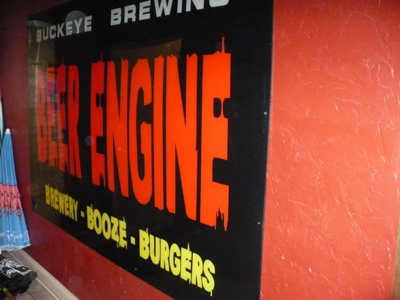
Last Wednesday, after our happy hour stint at Rocky River Brewing Co., the crew moved on to our dinner stop, the Buckeye Beer Engine in Lakewood. The Buckeye Beer Engine is a restaurant and pub, and while they don’t brew on site, they are affiliated with Buckeye Brewing, which is their production facility.

beer engine

The Beer Engine featured three selections from Buckeye Brewing on draft, as well as over 20 other draft and 100+ bottled craft beer selections. In a sense, it’s the best of all worlds. You get the brewery’s selections as you would in a brewpub, but you also have the variety of the rest of the craft beer world.

By the time we arrived at the Beer Engine, I had successfully worked up an appetite. It took about 6 hours to digest the chicken aglio e olio I had at Dadonna’s for lunch. (By the way, I literally got four meals out of that lunch portion. It’s no wonder we have a weight problem in America! But I digress…)

I naturally ordered the Buckeye Brewing sampler. To accompany my beer, I went with the schnitzel dinner. Not only do I search for beer I have never had, but I often look for the most rare and interesting food on the menu as well. It keeps life interesting. Since it’s rare to find schnitzel in South Carolina, it seemed only appropriate that I order it.

schnitzel

The schnitzel did not disappoint. It was delicious! It also came with potato pancakes, sauerkraut, applesauce and Martian Lager mustard. I love it when restaurants add fruit to dishes. When paired well, it always adds an unexpected sweet twist to a dish. The applesauce was a perfect contrast to the salty, fried schnitzel. (Try adding strawberries or blueberries to a salad. It always takes it up a notch.)

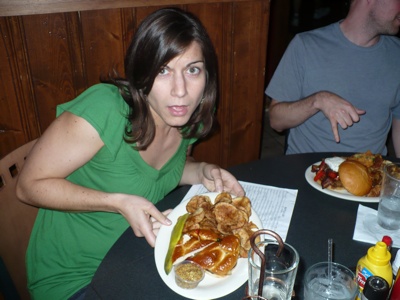
I also want to mention Nicole’s meal. She ordered the fried bologna sandwich on a pretzel bun. 5 ounces of bologna. That’s a third of a pound! Of bologna! As you can see from the picture below, she was beside herself. It was glorious!

fried bologna

Here are my thoughts from the Buckeye Brews that we sampled:

Buckeye Wheat Cloud
The cloudy yellow color lived up to the beer’s name. This wheat beer had spiced fruit character in the aroma and palate. Unlike Rocky River’s wheat beer, which finished sweet, the Wheat Cloud had a tart finish. It reminded me of an orange sweet tart.

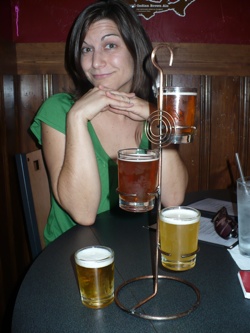
beer engine samplerYuppie ESB
Amidst the IPA hop explosion we’ve had over the past few years, English bitters have been brushed aside, so I was happy to see this on tap. There wasn’t much to the aroma, but true to the style, the Yuppie finished tart with a moderate bitterness. The flavor was bready with caramel malt.

76 IPA
A well-done IPA. The hop aroma was great. It smelled like a bowl of fruit loops. The strong citrus hop character was balanced out by a sweet, candied malt flavor.

Beer Engine Strong Ale
This was a cask ale selection on tap. I never got a clear answer as to where this beer came from, if it was one of Buckeye’s own, or another brewery’s strong ale, but either way I had to mention it. For one, I love cask conditioned beer. It is so velvety smooth, without all the CO2 bubbles getting in the way, the flavor explodes from the beer. This selection was no exception. Dark amber and menacing, it was a hoptastic beer, with hop aroma and flavor abounding throughout. I don’t know what the gravity was, but it had a very sweet malty body. It was well-balanced and big. It was definitely my favorite beer of the night.

Posted in Beer & Food, Beer spots, Breweries | Leave a comment